The Complete Guide to Electric Vehicles (EVs): The Future of Transportation
Electric vehicles are no longer just a futuristic idea seen in science-fiction movies. They are now becoming a part of everyday life. From electric scooters silently moving through crowded Indian streets to premium electric SUVs cruising on highways, the world is rapidly shifting toward cleaner transportation.
For many people, EVs represent hope — lower fuel costs, cleaner air, reduced dependence on petrol and diesel, and a smarter future. But at the same time, questions remain:
- Are EVs really practical?
- What are the different types of EVs?
- How do batteries work?
- Are they truly eco-friendly?
- What is the government doing to promote EVs?
- What challenges still exist?
This detailed guide answers everything about electric vehicles in a simple, human-friendly way.
What Is an Electric Vehicle?
An Electric Vehicle (EV) is a vehicle powered fully or partially by electricity instead of traditional fossil fuels like petrol or diesel.
Unlike conventional vehicles that use an internal combustion engine (ICE), EVs use electric motors powered by rechargeable batteries.
Think of it this way:
- Petrol vehicles burn fuel to create power.
- Electric vehicles use stored electricity to run the motor.
This makes EVs quieter, cleaner, and often cheaper to operate.
A Brief History of Electric Vehicles
Many people believe EVs are a modern invention, but surprisingly, electric cars existed in the 1800s before petrol cars became popular.
However, petrol vehicles dominated the market because:
- Fuel was cheap
- Oil infrastructure expanded quickly
- Battery technology was weak
The EV revolution restarted in the 21st century due to:
- Rising fuel prices
- Climate change concerns
- Better battery technology
- Government support
- Companies like Tesla changing public perception
Today, nearly every major automobile company is investing heavily in electric mobility.
Types of Electric Vehicles
Many people think every EV is the same, but there are several categories.
1. Battery Electric Vehicles (BEVs)
These are fully electric vehicles with no petrol or diesel engine.
They run entirely on batteries.
Examples:
- Tesla cars
- Tata Nexon EV
- MG Comet EV
Advantages:
- Zero tailpipe emissions
- Lower running costs
- Smooth driving experience
- Less maintenance
Disadvantages:
- Charging time
- Range anxiety
- Higher upfront cost
2. Hybrid Electric Vehicles (HEVs)
These vehicles combine:
- Petrol engine
- Electric motor
The battery charges automatically while driving.
Advantages:
- Better fuel efficiency
- No charging required
Disadvantages:
- Still uses fossil fuel
- Not fully eco-friendly
3. Plug-in Hybrid Electric Vehicles (PHEVs)
These are advanced hybrids where batteries can also be charged externally.
They can run:
- Short distances on electricity
- Longer distances using petrol
Best For:
People who want a transition between petrol and full EVs.
4. Fuel Cell Electric Vehicles (FCEVs)
These vehicles use hydrogen fuel cells to generate electricity.
Benefits:
- Fast refueling
- Long driving range
Challenges:
- Extremely expensive
- Hydrogen infrastructure is limited
Hydrogen vehicles are still in early development stages in most countries.
Categories of Electric Vehicles
EVs are not limited to cars anymore.
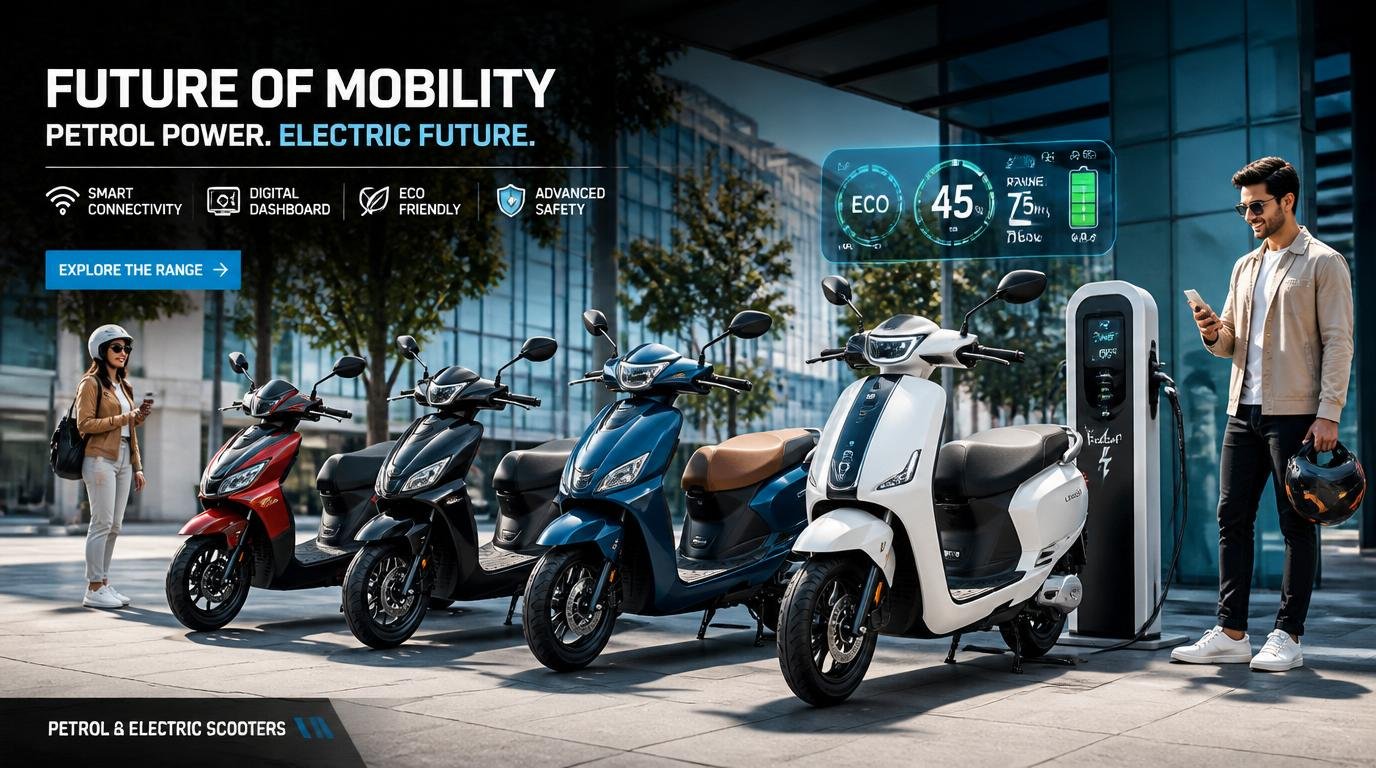
Electric Two-Wheelers
India’s EV revolution is heavily driven by electric scooters and bikes.
Popular because:
- Affordable
- Perfect for city travel
- Low charging costs
Examples include:
- Ola Electric scooters
- TVS iQube
- Ather scooters
Electric two-wheelers are currently the fastest-growing EV segment in India.
Electric Cars
These are becoming increasingly popular among families and professionals.
Common features:
- Instant acceleration
- Automatic driving experience
- Silent operation
Popular Indian EV cars include:
- Tata Punch EV
- Tata Nexon EV
- MG ZS EV
Electric Buses
Cities are rapidly adopting electric buses to reduce pollution.
Benefits include:
- Lower fuel expenses
- Reduced urban air pollution
- Quieter public transportation
Governments are investing heavily in e-bus fleets.
Electric Trucks
Electric trucks are emerging in logistics and commercial transportation.
India has even started deploying battery-swappable heavy-duty electric trucks in ports and logistics hubs.
Electric Rickshaws
E-rickshaws are transforming last-mile transport in India.
Why they became popular:
- Low operating cost
- Easy maintenance
- Affordable mobility solution
They are especially common in small cities and towns.
How Do Electric Vehicles Work?
The working mechanism of EVs is surprisingly simple compared to petrol vehicles.
Main Components
1. Battery Pack
Stores electrical energy.
2. Electric Motor
Converts electricity into movement.
3. Controller
Manages power flow between battery and motor.
4. Charging Port
Used for charging the battery.
5. Regenerative Braking
Converts braking energy into electricity and stores it back in the battery.
This improves efficiency and range.
EV Batteries Explained
The battery is the heart of an electric vehicle.
Common Battery Types
Lithium-Ion Batteries
Most widely used today.
Reasons:
- Lightweight
- High energy density
- Longer lifespan
Solid-State Batteries
Considered the future of EV technology.
Advantages:
- Faster charging
- Better safety
- Longer range
But they are still expensive and under development.
EV Charging Types
1. Slow Charging (AC Charging)
Usually done at home.
Time required:
- 5 to 10 hours
Best for overnight charging.
2. Fast Charging (DC Fast Charging)
Charges batteries much faster.
Time required:
- 30 minutes to 1 hour
Ideal for highways and long-distance travel.
3. Battery Swapping
Instead of charging, the empty battery is replaced with a charged one.
This technology is becoming popular for:
- Delivery fleets
- E-rickshaws
- Commercial EVs
Many experts believe battery swapping could become a major solution in India.
Advantages of Electric Vehicles
1. Lower Running Costs
Electricity is usually cheaper than petrol or diesel.
EV owners often save thousands annually on fuel.
2. Environment Friendly
EVs produce zero tailpipe emissions.
This helps reduce:
- Air pollution
- Carbon emissions
- Noise pollution
3. Less Maintenance
EVs have fewer moving parts.
No:
- Engine oil
- Clutch
- Gearbox complexity
This reduces servicing costs.
4. Better Driving Experience
EVs provide:
- Instant torque
- Smooth acceleration
- Quiet operation
Many first-time EV drivers are surprised by how refined they feel.
Challenges of Electric Vehicles
Despite rapid growth, EVs still face major challenges.
1. Range Anxiety
People fear the battery may run out before reaching a charger.
This remains one of the biggest concerns.
2. Charging Infrastructure
Charging stations are improving but still limited in many areas.
Infrastructure gaps remain a key challenge in many regions.
3. High Initial Cost
EVs usually cost more upfront than petrol vehicles.
However, lower operating costs may balance this over time.
4. Battery Replacement Cost
Battery replacement can be expensive.
Although batteries usually last many years, this remains a concern for buyers.
5. Electricity Dependency
Large-scale EV adoption requires:
- Stronger power grids
- Renewable energy expansion
- Better charging infrastructure
Government Policies Supporting EVs in India
India is aggressively pushing electric mobility.
The government sees EVs as important for:
- Reducing oil imports
- Fighting pollution
- Building domestic manufacturing
- Energy security
FAME Scheme
One of India’s most important EV initiatives was:
FAME (Faster Adoption and Manufacturing of Hybrid and Electric Vehicles)
FAME-I
Started in 2015.
FAME-II
Launched in 2019 with major financial support.
The scheme supported:
- Electric two-wheelers
- Electric buses
- Charging stations
- EV manufacturing
FAME-II played a major role in building India’s EV ecosystem.
PM E-DRIVE Scheme
India has now transitioned toward the:
PM E-DRIVE Scheme
(Prime Minister Electric Drive Revolution in Innovative Vehicle Enhancement)
This is currently India’s major EV policy framework.
Key highlights:
- Large-scale financial support
- Focus on EV adoption
- Charging infrastructure expansion
- Domestic manufacturing support
- Public transport electrification
The scheme also supports:
- Electric buses
- Trucks
- Charging networks
- Two-wheelers
- Three-wheelers
The government has extended incentives for certain EV categories till 2026 and beyond.
Production Linked Incentive (PLI) Scheme
India is also encouraging local EV manufacturing through the PLI scheme.
Goals include:
- Reducing dependence on imports
- Boosting battery manufacturing
- Strengthening domestic supply chains
Recent updates added stricter performance standards for electric vehicles under the PLI framework.
State EV Policies
Many Indian states have their own EV policies.
States like:
- Delhi
- Maharashtra
- Gujarat
- Tamil Nadu
- Karnataka
offer:
- Tax exemptions
- Subsidies
- Registration fee waivers
Some states have set highly ambitious targets for EV adoption and infrastructure development.
EV Charging Infrastructure in India
India is rapidly expanding its charging network.
Under current government initiatives:
- Thousands of charging stations are planned
- Highway fast chargers are being expanded
- Public charging support is increasing
Still, infrastructure growth must accelerate to support mass EV adoption.
The Global EV Revolution
Electric mobility is not just an Indian trend.
Countries worldwide are adopting EVs rapidly.
Major EV markets include:
- China
- United States
- Norway
- Germany
Many countries are planning to reduce or completely phase out petrol and diesel vehicles in the coming decades.
Environmental Impact of EVs
A common question is:
Are EVs truly eco-friendly?
The answer is nuanced.
Positives:
- Zero tailpipe pollution
- Lower greenhouse gas emissions
- Cleaner urban air
Concerns:
- Battery mining impacts
- Lithium extraction
- Recycling challenges
- Electricity generation from coal
Overall, most studies show EVs are cleaner over their lifetime compared to petrol vehicles, especially when powered by renewable energy.
EV Battery Recycling
Battery recycling is becoming a massive industry.
Old EV batteries can:
- Be reused for energy storage
- Recycled to recover materials like lithium, cobalt, and nickel
Battery recycling will become critical as EV adoption grows globally.
Future of Electric Vehicles
The future of EVs looks extremely promising.
Expected developments include:
- Faster charging
- Longer battery range
- Cheaper batteries
- More charging stations
- Better battery recycling
- Autonomous EVs
- Smart connected vehicles
Experts believe electric mobility will eventually dominate transportation.
Are EVs Worth Buying Today?
The answer depends on your needs.
EVs Are Great For:
- Daily city commuting
- Predictable travel distances
- Lower fuel expenses
- Eco-conscious buyers
Petrol/Diesel May Still Suit:
- Frequent long highway journeys
- Areas with poor charging infrastructure
- Heavy towing requirements
For many urban users, EVs are already practical and economical.
The Human Side of the EV Revolution
Beyond technology and policies, the EV movement is also emotional.
For some people:
- EVs mean cleaner air for their children.
- For drivers, it means relief from rising petrol prices.
- For startups, it means innovation opportunities.
- For governments, it means energy independence.
The transition will not happen overnight. Petrol and diesel vehicles will remain relevant for years. But the direction is clear — transportation is becoming electric.
And just like smartphones changed communication forever, electric vehicles are preparing to redefine mobility itself.
The road ahead may still have challenges, but the EV revolution has already begun.